Showing posts with label review. Show all posts

Friday, June 18, 2010

Podcasts and Flat Classroom...


Today we used the audio I recorded last night along with more recorded today (thank you to our guest voices) to create our first podcast. Using GarageBand, we added music and edited our audio, and I am very happy with the result and the process. As with anything, preparation was the key. The 5 minute outline Dr. Z provided and the script we wrote made it easy to record and edit a five (and a half – oops) minute podcast.

I wish I had time to listen to some podcasts right now. I’m interested in a podcast from EdTechTalks. The topic is the COPE strategy for professional development. COPE stands for Collaboration, Organization, Periodicals, and Education. I’m not usually a fan of cute acronyms with multiple meanings, but I think this one has some potential. I’ll withhold judgment until I get a chance to listen, and hopefully I’ll remember to since I included it here.

For both of the graduate classes, we are collaborating with our classmates. It’s difficult to keep everything straight…who am I working with right now? Which project are we thinking about now? When is this due? It makes me think about how our students feel sometimes when they’re working in groups in different classes. Usually the work is done in class and they don’t have to use collaboration tools to communicate with members from afar, but what happens when I introduce a Flat Classroom Project or we finally have a chance to do Virtual Teaming? Will the additional technology and requirements cause them stress like we are feeling now, or is this just a result of our unusual circumstances?

Usually I like summer courses, and I don’t dislike this one, but I don’t think I was mentally prepared for finishing the school year and then going right to school. I’m not going to stress out about how my students will react to new projects and new experiences. I know they’re more flexible than my tired, old brain so I will prepare them as best I can and support them if they start feeling the stress.

Wednesday, June 16, 2010

"Let's make more podcasts..."


I asked my friend Alex to help me create some audio for a podcast Carrie, Cathy and I are creating for the EIT final project. Alex is great at odd voices and ad-libbing bluster and surprise. So Alex and I met in Brandon, Iowa half-way between Cedar Rapids and Cedar Falls. Brandon is home of Iowa's Largest Frying Pan, but not much else - certainly no convenient Wi-Fi spots. So when I decided to use Andrew Carnegie, for whom I had no research, instead of Nikola Tesla as an interviewee, I panicked -for a moment.
Enter the Kindle. My Kindle uses the 3G network, not Wi-Fi so as long as there were some cell towers around Brandon, I could access Wikipedia. I never thought that Wikipedia would save the day, but it did. Not only did we get the Edison interview done, but we also recorded Carnegie. When we were finished, Alex said "You know, we should do more of these technology history podcasts. You can do the research and I'll write the scripts!"
I don't think he knows about the additional work we'll do with GarageBand, but it was great to see someone outside the cohort enthusiastic about the technology and what we're teaching. I'm excited about this project, and I'm excited that teachers from different disciplines can work together to create a project relevant to our students. Go team!

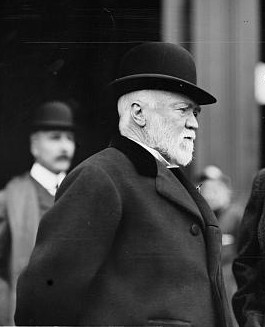
Picture of Andrew Carnegie from Wikicommons.

Monday, June 14, 2010

Tweets, skype, and Google Docs, Oh my!


What a whirlwind experience today's class was. It was very nice to meet everyone in person, but today I really felt for the first time that in person isn't very important. First, we had the wonderful conversation with CoolCatTeacher Vicki Davis using Twitter and Skype, and then we worked in groups scattered around the building.

I also have hope for our IT department. I know I am very negative about my relationship with them, but I'm going to try to frame things differently in the future. I'm going to take everyone's suggestions today about how to approach implementing new applications to heart. I'm even going to embrace the Software Evaluation form and try to visit them this summer. Do you think they will respond to gifts of food or candy?

The wide variety of applications that Google offers will help me determine which battles need to be won with my IT people. Do I need a piece of software for students to collaborate on a word processing document or to chat? No, we can use Google. I need to do more research into diigo and delicious to determine if they will work without downloading a toolbar without compromising their usefulness...holy cow Vicki Davis knows how to make diigo work for her!

So today, our first day in the classroom, I finally realized that we can do a lot without the classroom. I also realized that one of the best things I can do for my students is to be silent sometimes so they can solve the problem themselves.

Image from: http://macdevcenter.com/mac/2003/06/24/graphics/figure_2_chatting.jpg

Saturday, June 5, 2010

Technology Directors In or Out?


Education Needs Geeks according to Don Watkins, guest blogger on Dangerously Irrelevant. The thing is education needs the right geeks. Here is a quote from his eloquent post:
“A technology director ought to be a bit of a rebel, a diplomat, and a life long learner. Today's technology directors have to work together with curriculum directors and technology integrators to make sure that today's students are really being prepared for the twenty-first century. Today's technology directors must be agents of change, they have to envelope pushers but at the same time they have to work with other professionals who can shape curriculum. No one can do everything and certainly not everything well without help.”

Mr. Watkins is inspiring if you aspire to be a technology director. He writes about his evolution from a guy with no experience and a liberal arts degree into a maverick who challenges the system and programs with Linux. I'm pretty sure that most of us in the Instructional Technology master's program aren't destined to start working in Linux, but it probably would be a good idea for us to learn more about open source. In our textbooks, the authors talk about customization and open source providing more opportunities for learning.

But I digress, Watkins' post is actually a response to another post by Doug Green Should We Get Rid of Technology Directors? Green points out that "top down decisions are less likely to enjoy successful adoption in education than in other organizations." If teachers implement technology or work with their peers, though, they feel in control and have ownership. "When a technology innovation comes to the classroom by way of the technology director it is likely to focus on the technology. When it arrives as the result of initiatives owned by the teachers, it is more likely to focus on the content. "
Green proposes that technology directors phase themselves out into administrative positions or back into the classroom. Instead, we should have teams at the building level who make decisions about instructional technology. Empowering teachers, administrators, and even students to implement instructional technology decisions means they're more likely to work.

So, which is it? Do we need Linux using geeks to show us how it's done? Or do we need to step up to the plate and nudge our co-workers up with us? I don't know. Like many other choices, it's probably a little bit of both.

Monday, May 31, 2010

Rewiring Our Brains


I'm a geek. I always have been, but what can I say? I love to learn, and technology helps me, but is it also rewiring my brain? According to Nicholas Carr in the article The Web Shatters Focus, Rewires Brains, using the internet and technology to multitask is rerouting our neural pathways. Introducing hyperlinks (like I just did) into text " disrupts concentration [and] such activity weakens comprehension."
Mr. Carr describes several different experiments including scanning surfers' brains with MRIs and reading text only information vs. information with video, and the results are in: humans don't process information as well when we are not focused. I'm not really that surprised by the information presented in the article. As I stated in my first blog, the sheer volume and variety of information and resources required by the EIT and MPP classes makes it more difficult to process, relate to and store. I have a hard time remembering what I have finished and what I need to do because I have to access so many different resources...that in turn link to so many other resources...that in turn....
According to the article, psychologist Patricia Greenfield concluded that the benefits of the internet “go hand in hand with a weakening of our capacity for the kind of ‘deep processing’ that underpins ‘mindful knowledge acquisition, inductive analysis, critical thinking, imagination, and reflection.’” I find it interesting that the online version of this article contains hyperlinks in several paragraphs. The whole point is that those hyperlinks are making it more difficult to learn the information in the article.
A resource for those of you who also find the web distracting is Readability. It will filter all the ads…but not the hyperlinks. Just resist the temptation to click on the pretty blue words.

Picture of Andrew Carnegie
Wikipedia page